English
A receptionist adjusting an oversized blazer before greeting a client, a server tugging at a restrictive waistband during a busy service, or a clinic team wearing mismatched shades of the same uniform all send a message. The message may be unintentional, but customers notice it. Made to measure uniforms help businesses replace these small visual and practical failures with apparel that looks considered, feels comfortable, and represents the organization with confidence.
For organizations where staff are visible to customers, patients, guests, partners, or visitors, uniforms are not simply clothing. They are part of the operating standard. A well-designed uniform gives employees a shared professional appearance while accounting for the real demands of their roles, from long shifts and frequent movement to varying workplace temperatures and daily laundering.
Why Made to Measure Uniforms Perform Better
Ready-made garments are designed around generalized sizing. That approach can work for a basic promotional shirt or a short-term event, but it often falls short when uniforms are worn every day. Teams include different body types, job functions, and comfort preferences. A single cut rarely serves all of them well.
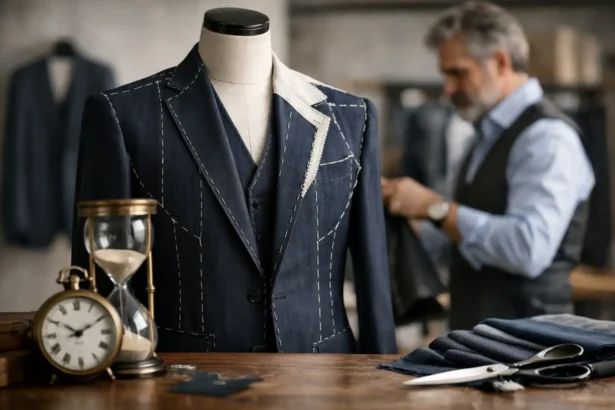
Made to measure uniforms use individual measurements or structured size assessments to create a more accurate fit. The result is not only more polished. It is more functional. A jacket that sits correctly through the shoulders, pants with the right rise and length, and shirts that allow natural movement give employees fewer reasons to feel distracted during the workday.
Fit also affects how a garment holds its shape. When fabric is constantly pulling across the chest, straining at the hips, or bunching at the sleeves, it wears out faster and looks less refined. Better proportion supports a cleaner silhouette and can help extend the useful life of professional apparel.
This does not mean every organization needs an entirely unique pattern for every employee. The right approach depends on the program. A leadership team may require individually tailored suits, while a hotel or restaurant may benefit from coordinated styles with measured adjustments to key areas such as sleeve length, waist, inseam, and shoulder fit. The objective is practical precision, not unnecessary complexity.
Professional Fit Supports Employee Confidence
Employees are more likely to wear a uniform with pride when it feels as though it was made for them rather than assigned to them. This matters in customer-facing environments, where posture, confidence, and approachability shape the service experience.
In hospitality, a front-of-house team needs to look polished through a full shift while moving quickly between guests, tables, and service areas. In healthcare, comfort and mobility may take priority, but the visual standard must still communicate cleanliness, care, and authority. In finance and corporate settings, tailored blazers, shirts, trousers, and skirts can reinforce a sense of credibility during every meeting and client interaction.
The strongest uniform programs respect both the brand and the people wearing it. When staff can bend, walk, reach, sit, and work without constant adjustment, the uniform becomes a reliable part of the job rather than a source of frustration.
Fabric Choice Is a Business Decision
A precise fit is only one part of a successful uniform. Fabric determines how the garment performs after repeated wear, washing, pressing, and movement. The most attractive material on a sample card may not be the best choice for a fast-paced restaurant, a warm outdoor setting, or a clinical environment requiring frequent laundering.
A uniform design consultation should begin with the workplace itself. Consider the temperature, shift length, physical activity, cleaning requirements, and expected level of formality. A polished corporate suit may call for breathable suiting with structure and wrinkle resistance. A hotel team may need durable, easy-care fabrics that retain their color. Restaurant staff often benefit from materials that balance comfort, stain resistance, and a crisp appearance under demanding service conditions.
Color selection also deserves careful attention. Brand colors should look consistent across different garments and production runs, but they must also suit the environment. Very light colors can show stains quickly. Deep shades may fade if the fabric quality and dyeing process are weak. A professional uniform supplier helps businesses weigh visual impact against the realities of daily use.
Design for Roles, Not Just Departments
A cohesive uniform does not require every employee to wear the exact same garment. In fact, forcing one style across every role can make a program less practical. The better strategy is to create a connected wardrobe system.
For example, a hotel may use a shared color palette, fabric family, and logo treatment across reception, concierge, housekeeping, management, and food service. Each team can then wear garments suited to its work. Front desk staff may wear tailored blazers and formal shirts, while operational teams use durable shirts, pants, or aprons that maintain the same brand identity.
The same principle applies to corporate offices, clinics, restaurants, and retail spaces. Consistency comes from thoughtful design elements: coordinated colors, recurring trims, logo placement, buttons, piping, and garment silhouettes. Distinction comes from adapting the uniform to the role.
This approach also makes it easier for customers to identify who can help them. A supervisor, host, nurse, or service team member can be visually recognizable without breaking the overall presentation of the organization.
Branding Should Look Integrated, Not Added On
Embroidery and printing can turn professional apparel into a clear brand asset, but placement and execution matter. A large logo in the wrong position can overpower an otherwise refined garment. Poor-quality embroidery can pucker fabric or lose definition over time. The goal is to make branding feel intentional.
For formal uniforms and corporate attire, subtle embroidery on the chest, cuff, collar, or pocket area often creates a more premium effect. For operational or promotional apparel, larger printed elements may be appropriate when visibility is the priority. The choice depends on the audience, garment type, and setting.
Branding is also more than a logo. The selected fabric, cut, color, and finishing details all communicate something about the company. A structured blazer suggests authority. A thoughtfully tailored shirt signals attention to service. An apron with well-placed embroidery can make a restaurant team look established and coordinated. Every element should support the identity the business wants customers to experience.
Planning a Uniform Program That Lasts
The most common mistake businesses make is treating uniforms as a one-time purchasing task. A uniform program is more effective when planned for scale, replacement needs, new hires, and seasonal changes from the beginning.
Start by defining which roles need uniforms and what each role must be able to do while wearing them. Then establish core garments, optional layers, approved colors, and branding standards. It is also wise to consider how replacements will be managed. Employees join, change roles, and need additional pieces. A consistent production partner helps maintain the same appearance as the team grows.
Before approving a large order, review samples in real working conditions. Ask employees to sit, walk, reach, and work in the garments. Check how the fabric responds after laundering and whether the colors, logo, and fit remain consistent. A sample that looks excellent in a meeting room but performs poorly on a busy shift is not the right solution.
Budget should be evaluated over the useful life of the garment, not only by unit price. Lower-cost uniforms that fade, distort, or require frequent replacement can become more expensive than well-made apparel designed for repeat wear. Quality craftsmanship, correct fabric selection, and dependable fit protect both the investment and the brand image.
A More Considered Standard for Team Apparel
Made to measure uniforms give businesses the opportunity to set a higher standard without losing practicality. They bring fit, fabric, branding, and role-specific function into one coordinated decision. For teams that represent the business every day, that level of care is visible.
Velcoor approaches uniform development as a professional image-building process, combining consultation, precise fitting, fabric selection, custom branding, and production support for organizations that expect more from their staff apparel.
The best next step is simple: bring together a small group of representative employees, identify what is not working with the current uniform, and test a proposed design in the conditions where it will actually be worn. The right uniform should look impressive when the day begins and still support the team when the shift is at its busiest.