English
The difference between a blazer that merely fits and one that strengthens a company’s image is obvious the moment a team walks into a lobby, meeting room, or client site. Corporate blazer tailoring is not just about adjusting sleeve length or taking in the waist. It is about building a garment that supports brand standards, employee comfort, and the level of professionalism your business wants to project every day.
For organizations that rely on staff presentation, the blazer carries unusual weight. It sits at the center of the uniform, often becoming the most visible expression of your standards. When the cut is clean, the fabric is right for the work environment, and the details reflect your brand, the result feels intentional. When it is generic, poorly fitted, or inconsistent across the team, even an otherwise polished uniform can look incomplete.
Why corporate blazer tailoring matters
A tailored corporate blazer does more than make employees look sharper. It creates consistency across different body types, departments, and day-to-day responsibilities. That consistency matters in industries where trust, service quality, and first impressions directly affect customer confidence.
In hospitality, a blazer needs to look refined through long shifts while allowing movement at the front desk, in concierge roles, or during guest interactions. In finance or corporate offices, the blazer often serves as a visual extension of authority and discipline. In premium retail, healthcare administration, and executive-facing environments, it helps signal professionalism before a word is spoken.
Ready-made options can appear cost-effective at first, but they often create visible variation across a team. One employee may have shoulders that fit but sleeves that run long. Another may feel restricted when seated or moving. Over time, these issues affect appearance, comfort, and garment lifespan. Tailoring addresses those variables directly instead of forcing employees into standard sizing that rarely works equally well for everyone.
What good corporate blazer tailoring should achieve
The best results come from balancing image and function. A blazer for business use cannot be judged only by how it looks on a hanger. It needs to perform across daily wear, repeated cleaning, and different work settings.
A well-tailored blazer should create a neat shoulder line, a clean drape through the chest and back, and a silhouette that feels professional without looking rigid. It should also accommodate the realities of the role. A client-facing executive may prefer a more structured shape and premium suiting fabric. A hotel team may need a softer construction with easier movement and greater wrinkle resistance. A restaurant host team may require a polished finish that still handles heat, pace, and frequent wear.
That is where consultative tailoring matters. The right tailoring partner does not begin and end with measurements. They assess job function, brand tone, climate, maintenance needs, and the visual hierarchy of the uniform. A blazer for managers should not necessarily be identical to one for front-line staff, but the overall look should still feel unified.
Fit is the first standard
In corporate blazer tailoring, fit is where credibility begins. Even high-quality fabric can look average if the balance is wrong. Conversely, a sensible fabric can look significantly more refined when the fit has been properly developed.
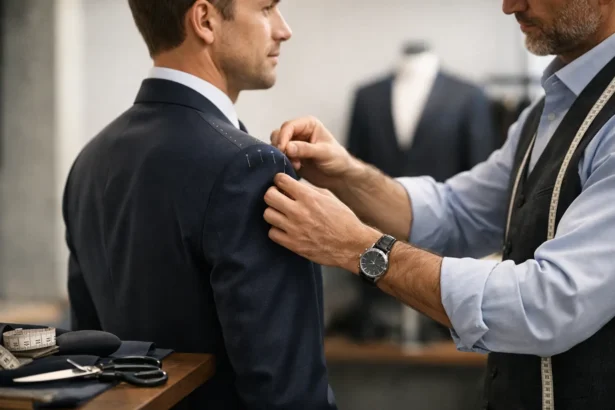
The shoulders are the starting point. If the shoulder width is off, the entire blazer loses structure. From there, the chest, waist, lapel stance, sleeve length, and jacket length all need to work together. For business teams, the goal is usually not an aggressively fashion-forward fit. It is a polished, professional line that flatters a wide range of employees while remaining appropriate for the industry.
This is also where made-to-measure offers a practical advantage over standard retail sizing. Businesses rarely have teams made up of people who fit one pattern cleanly. Height differences, posture, body shape, and movement requirements all affect how a blazer should be cut. Tailoring allows these differences to be handled professionally rather than treated as exceptions.
Fabric choices shape performance
Fabric selection is one of the most underestimated parts of a blazer program. Decision-makers often focus first on color and price, but fabric determines how the garment wears, breathes, drapes, and lasts.
For corporate use in warm climates and indoor-outdoor work environments, breathability matters. For high-contact client settings, crease resistance and surface appearance may matter more. For teams that wear blazers daily, durability and ease of care quickly become operational concerns, not just style preferences.
Wool blends are often favored for their structured appearance and refined drape, but depending on the role, polyester blends or performance fabrics may offer better resilience and lower maintenance. There is no single best choice for every business. The right answer depends on shift length, environment, frequency of wear, and the level of polish expected.
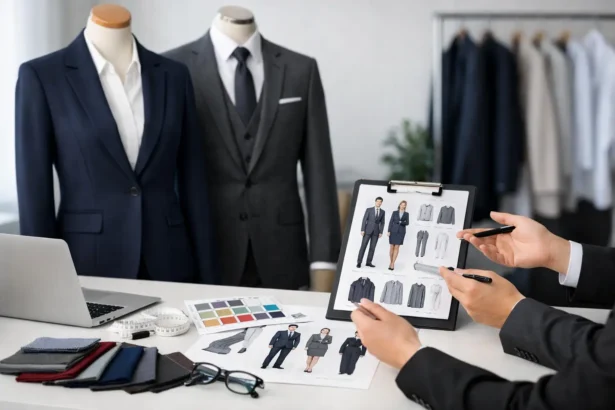
Color also deserves more strategy than many companies give it. Navy, charcoal, and black remain dependable choices because they align easily with formal business dress codes and pair well with shirts, trousers, and skirts. But a blazer can also support brand identity through carefully selected tones, contrast piping, lining details, or embroidery placement. Those choices should feel controlled and professional, not decorative for its own sake.
Branding without overstatement
A corporate blazer should represent the brand clearly, but subtlety usually delivers the strongest result. Good branding in tailoring is integrated, not loud.
Embroidery, monograms, custom buttons, internal labels, piping, and coordinated linings can all reinforce identity without compromising professionalism. For some businesses, a discreet logo on the chest or sleeve is appropriate. For others, branded details are better kept inside the garment or coordinated through color and finishing.
This is especially important for companies managing multiple job roles. Senior staff, reception teams, operations managers, and service personnel may need slightly different expressions of the same brand. Corporate blazer tailoring makes it possible to maintain one visual language while adapting the garment to each role.
Consistency across teams is where tailoring proves its value
When companies order uniforms at scale, inconsistency is one of the most common problems. Slight differences in fit, fabric tone, or construction can make a team look assembled rather than intentionally presented. That weakens the impression of order and quality.
A structured tailoring process helps avoid this. It creates a repeatable standard for measurements, style details, fabric selection, branding placement, and finishing. That matters for companies onboarding new hires, expanding departments, or replacing garments over time. Without a consistent specification, reordering can quickly become uneven.
For growing businesses, this is not a minor issue. Uniform inconsistency affects procurement efficiency, employee satisfaction, and brand presentation at the same time. A proper tailoring program turns the blazer into a managed business asset rather than a one-time apparel purchase.
The right process makes the difference
Successful corporate blazer tailoring depends on process as much as craftsmanship. Businesses need more than a tailor who can alter garments well. They need a partner who can guide design decisions, manage fittings, advise on fabric suitability, and produce consistently across team sizes.
That process typically begins with understanding the business itself. What impression should the team give? How formal should the blazer feel? Which employees wear it daily, and which wear it only for meetings or front-facing duties? How much movement does the role require? What is the expected replacement cycle?
Once those questions are answered, measurements and fitting sessions become more effective because they are tied to a clear use case. Prototype development, wear testing, and review of finishing details help prevent costly mistakes before full production begins. This is where an experienced provider adds real value. The goal is not just to deliver blazers, but to deliver confidence that the final result will hold up in practice.
Velcoor approaches this work as both tailoring and brand presentation, helping businesses develop blazers that are measured, functional, and aligned with the image they want their teams to carry.
When custom tailoring is the better investment
Not every company needs the same level of customization. A small office with occasional formal events may not require a fully developed blazer program. But for organizations with customer-facing teams, multiple departments, frequent staff interaction, or strong brand standards, custom tailoring usually delivers better long-term value.
The investment tends to pay back in three areas. The first is appearance, because the team looks more cohesive and credible. The second is wearability, because employees are more likely to use garments confidently when they fit well. The third is durability, because appropriate fabrics and proper construction usually outperform low-cost ready-made alternatives under regular use.
There are trade-offs, of course. Custom programs require planning, fittings, and more decision-making upfront. They also require a supplier capable of maintaining quality over repeat orders. But for businesses serious about presentation, those steps are often what separate a serviceable uniform from one that actively strengthens the brand.
A corporate blazer should not feel like an afterthought added late in the uniform process. It should feel like the centerpiece of a professional image system – one built with precision, worn with ease, and recognized for the standards it represents. When tailoring is handled properly, the blazer stops being just another garment and starts doing quiet, consistent work for the business every single day.