English
A front desk team in mismatched jackets, servers in shirts that wrinkle by noon, or clinic staff adjusting ill-fitting uniforms between appointments – these details shape how customers judge a business long before a conversation begins. A strong corporate uniform design service addresses that problem at the source by turning workwear into a practical extension of your brand, your standards, and your day-to-day operations.
For businesses that rely on presentation, consistency, and staff confidence, uniforms are not a side purchase. They are part of the customer experience. They affect first impressions, team cohesion, comfort on the job, and the credibility of your brand in every client-facing moment.
What a corporate uniform design service should actually deliver
A proper corporate uniform design service does more than offer a catalog and add a logo. It starts with how your business operates, how your staff move, what your customers expect to see, and what level of formality supports your brand image.
That process matters because different industries need different solutions. A hotel reception team may need tailored blazers that hold structure through long shifts. A restaurant may need breathable shirts and aprons that balance refinement with stain resistance. A healthcare group may prioritize ease of movement, wash durability, and role-based color coding. The design approach should reflect those realities rather than forcing every team into the same template.
The best results come from consultation, not guesswork. This means evaluating job roles, garment categories, fabric performance, climate considerations, brand colors, and the practical demands of repeated wear. When these factors are handled early, the final uniform program is more consistent, more wearable, and more cost-effective over time.
Why custom design outperforms ready-made options
Ready-made uniforms can seem efficient at first. They are easy to order, quick to replace, and often priced to appeal to budget-conscious buyers. But for many businesses, that short-term convenience creates long-term inconsistency.
Fit is usually the first issue. Standard sizing rarely accommodates the full range of body types across a real workforce, especially when teams include both front-of-house and managerial staff with different presentation needs. Poor fit affects appearance, but it also affects comfort and confidence. Staff who feel restricted, oversized, or visibly uncomfortable are less likely to wear their uniforms well.
Brand alignment is another common gap. A generic blazer in the wrong shade, a shirt with limited fabric choices, or a logo applied as an afterthought does not create a polished visual identity. It creates a partial one. A custom corporate uniform design service closes that gap by building garments around your brand rather than trying to force your brand into off-the-shelf options.
There is also the question of durability. Lower-cost uniform programs can result in frequent replacement cycles due to fading, weak seams, shape loss, or fabric breakdown. For companies outfitting multiple employees, replacement costs and image inconsistency can quickly outweigh the initial savings.
The role of fit in professional image
Fit is often treated as a detail. In practice, it is one of the clearest indicators of quality. A well-designed uniform should look intentional on the body, not simply acceptable on a hanger.
For customer-facing industries, this has direct business value. Tailored jackets, properly cut trousers, structured shirts, and skirts designed for movement create a cleaner silhouette and a more composed team presence. In sectors such as finance, hospitality, luxury retail, and executive services, that visual precision supports trust.
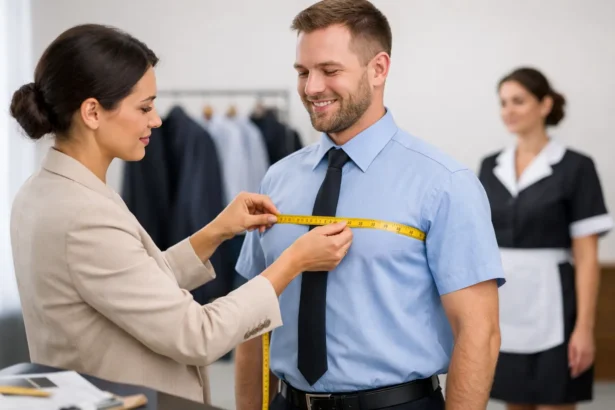
At the same time, fit cannot be purely aesthetic. Staff must be able to move, bend, reach, walk, and work through full shifts without distraction. That is why a consultative service often produces better outcomes than basic supply. Measuring, fitting, and adjusting garments according to role creates a better balance between formality and function.
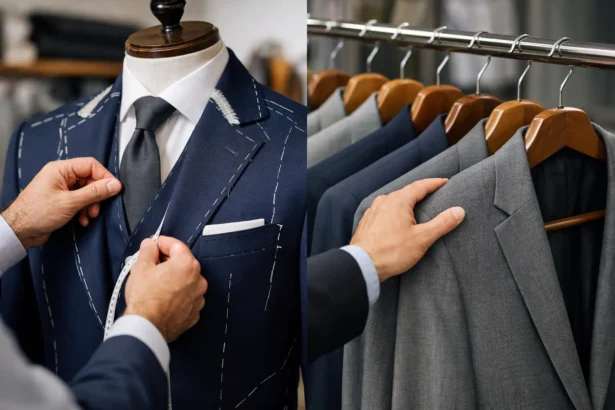
This is where craftsmanship makes a visible difference. Precision in pattern selection, cut, stitching, and finishing helps uniforms keep their shape and maintain a professional look over repeated wear.
Fabric selection is a business decision
Fabric is not just a style choice. It influences comfort, maintenance, longevity, and how well the uniform represents your standards throughout the day.
A polished appearance in the morning means very little if shirts crease heavily before lunch or if blazers lose structure after regular use. Likewise, a fabric that looks premium but traps heat may not suit teams working in warmer environments or moving between indoor and outdoor settings.
A strong corporate uniform design service should guide businesses through fabric options based on actual use. That includes weight, breathability, wrinkle resistance, color retention, stretch, ease of care, and how the material handles repeated laundering. For some organizations, a refined suiting fabric is the right choice. For others, performance blends may offer better day-to-day value.
There is always a trade-off. Premium fabrics can elevate appearance and comfort, but they may require more careful maintenance. More durable blends can simplify care, though they may offer a slightly different hand feel or drape. The right choice depends on your brand position, operational pace, and replacement expectations.
Branding details that make uniforms cohesive
A logo alone does not create a branded uniform. Cohesion comes from the full visual system – garment color, silhouette, trim, embroidery placement, printing methods, and consistency across roles.
For example, a hospitality group may want reception, concierge, housekeeping, and management uniforms to feel connected without looking identical. A restaurant may need kitchen, floor staff, and hosts to have distinct functional garments while still appearing part of the same brand family. A clinic may want clear role differentiation while preserving a calm, professional image.
This is where design guidance becomes especially valuable. The right service helps define what should stay consistent and what should vary by department. Often, subtle decisions have the greatest impact: piping in brand colors, embroidery positioned for visibility without clutter, shirt styles matched to hierarchy, or blazers reserved for key client-facing roles.
When done properly, branding feels integrated rather than decorative.
Industry-specific design leads to better results
Uniform needs vary widely by sector, and one of the clearest signs of a capable provider is the ability to design accordingly.
Hotels and front-office teams often need elegance, structure, and all-day wearability. Restaurants need a blend of presentation, flexibility, and easy-care practicality. Healthcare environments demand hygienic, washable, role-appropriate garments that still look professional. Corporate offices may prioritize executive tailoring, smart business formals, and a polished but approachable team image.
Even within one organization, needs can differ from role to role. Senior management may require tailored suits or blazers, while support staff need lighter garments for mobility and comfort. A thoughtful design service recognizes these differences and builds a uniform program around them instead of flattening every role into a single look.
That approach also helps with adoption. Employees are more likely to wear uniforms confidently when the garments suit their responsibilities and feel appropriate to their work environment.
What to look for in a corporate uniform design service
If you are comparing providers, look beyond pricing and garment photos. The quality of the process often determines the quality of the final result.
A dependable partner should be able to guide consultation, propose suitable styles, explain fabric options clearly, manage measuring and fitting, handle customization such as embroidery or printing, and produce uniforms consistently across teams and reorders. This is especially important for growing organizations that may need future additions without losing consistency.
It also helps to ask practical questions. How are fittings handled for larger teams? Can designs be adapted across departments? What fabrics are recommended for your work environment? How is sizing managed for employees with different fit needs? What happens when a reorder is needed months later?
These are not minor details. They affect rollout speed, employee satisfaction, and the long-term value of the investment.
For many Malaysian businesses serving demanding customer-facing markets, working with a specialist such as Velcoor offers a clearer path than assembling uniforms from multiple vendors. A single service that covers consultation, design, fit, customization, and production reduces friction and usually results in a more coherent standard.
Good uniforms support operations, not just appearance
The strongest uniform programs succeed because they balance image with usability. They help teams look professional, but they also simplify dress standards, improve consistency across locations, and give staff a clearer sense of belonging to the organization.
That operational value is easy to underestimate. When uniforms are designed well, managers spend less time correcting presentation issues. New hires are integrated more smoothly. Reorders are easier to manage. Teams show up looking aligned without constant oversight.
A corporate uniform design service is most valuable when it treats apparel as part of business infrastructure, not just branding material. The right garments should work hard, wear well, and present your company with the same level of discipline you expect from your people.
If your team’s appearance matters to your customers, then your uniform standard deserves the same care you give every other part of the brand experience.