English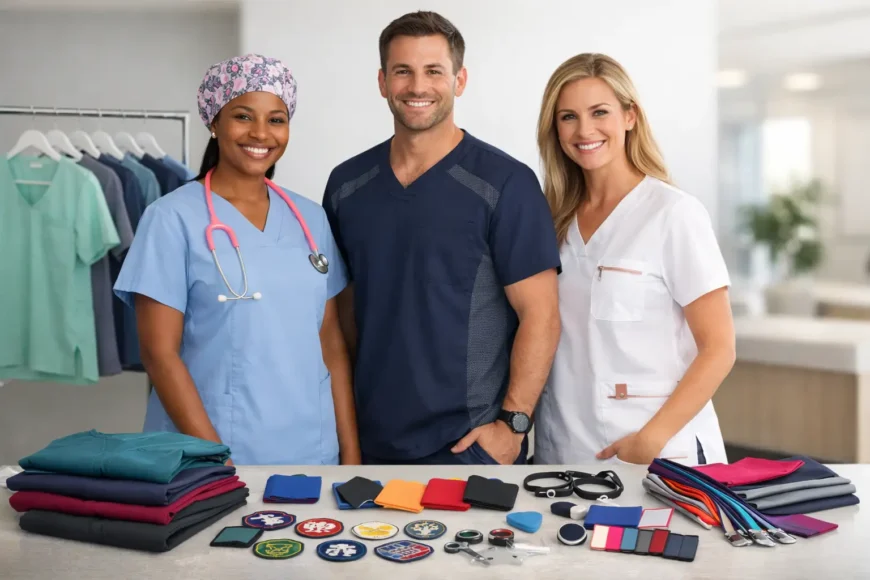
A clinic front desk in crisp branded attire sends one message. A nursing team in poorly fitted scrubs sends another. In healthcare, presentation is not a cosmetic detail. It shapes trust, supports team identification, and affects how comfortably employees can move through long shifts. That is why healthcare uniform customization options matter far beyond logo placement or color choice.
For hospitals, clinics, dental practices, specialist centers, and care facilities, the right uniform program needs to balance brand image with practical use. Staff work in different roles, body types vary widely, laundering is frequent, and comfort cannot be treated as optional. A well-designed healthcare uniform should look professional on day one and still perform after repeated wear.
Why healthcare uniform customization options matter
Healthcare environments ask a great deal from workwear. Reception staff often need a more polished, front-facing appearance. Nurses and technicians need mobility, breathability, and functional storage. Administrative leaders may want a consistent visual identity across departments without forcing every employee into the same garment.
That is where customization becomes valuable. Instead of buying generic stock uniforms and hoping they suit the team, organizations can shape the garments around their workflow, brand standards, and wear expectations. The result is usually stronger consistency, better employee comfort, and a more credible public image.
There is also a practical procurement benefit. Standard ready-made uniforms can appear cost-effective at first, but poor fit and short lifespan often lead to reorders, complaints, and uneven presentation across the team. Customization gives decision-makers more control over fabric performance, sizing strategy, and branding details from the beginning.
The main areas of healthcare uniform customization
Not every healthcare organization needs full bespoke design, but most benefit from tailoring the essentials. The strongest uniform programs usually start with four core areas: style, fit, fabric, and branding.
Garment style by role
Different job functions call for different uniform designs. Scrub tops and pants remain the standard for many clinical roles, but they are not the only option. Medical tunics, tailored lab coats, consultation jackets, branded polos, formal front-desk shirts, and modest-cut options all have a place depending on the setting.
A private clinic may want reception staff in structured shirts and trousers while clinical staff wear coordinated scrubs in the same brand palette. A dental practice may prefer tunics with cleaner lines and a more premium finish. A specialist center may separate departments through subtle design differences rather than using entirely different uniforms.
The key is not variety for its own sake. It is role-appropriate consistency. Uniform design should reflect what each team member actually does during the day.
Fit and sizing options
Fit is where many healthcare uniform programs succeed or fail. Generic sizing can create problems quickly. If a top pulls at the shoulders, rides up during movement, or fits too loosely around equipment, staff notice it immediately. Patients notice it too.
Customized sizing options can range from expanded size runs to made-to-measure adjustments for key personnel or client-facing teams. Sleeve length, trouser rise, body length, and overall cut all influence comfort and appearance. In healthcare, where shifts are long and movement is constant, a good fit supports confidence as much as it supports presentation.
There is a trade-off here. Full made-to-measure production offers the highest level of precision, but it may not be necessary for every role or every team size. For many organizations, a hybrid approach works well: standardized core sizing supported by fit adjustments where needed.
Fabric selection for performance
Fabric is one of the most important healthcare uniform customization options because it directly affects durability, comfort, and maintenance. The best fabric choice depends on the environment. A front-office uniform may prioritize structure and wrinkle resistance, while clinical garments may need stretch, breathability, and easy-care performance.
Common priorities include moisture management, softness, ease of movement, color retention, and wash durability. In higher-temperature settings or fast-paced departments, lighter-weight fabrics with stretch can improve day-to-day wearability. In premium private practices, the visual finish of the fabric may matter just as much as technical performance.
There is no single best material for every healthcare setting. A fabric that looks sharp in reception may not suit clinical use. A fabric that feels light and flexible may require more careful construction to maintain a polished shape over time. Choosing well means looking at actual wear conditions, not just fabric swatches in isolation.
Branding and visual identity
Branding should feel integrated, not added on at the last minute. Embroidered logos, printed identifiers, color-matched trims, department labels, and branded name placements can all strengthen visual consistency when applied with restraint.
In healthcare, subtle branding usually performs better than heavy branding. A neatly embroidered logo on the chest, a clean departmental identifier, or coordinated brand colors in piping or collar detail often creates a more credible professional result than large graphic treatments.
This is especially important for organizations positioning themselves as premium, patient-centered, or clinically refined. Uniform branding should reinforce trust and professionalism, not compete with it.
Function matters as much as appearance
Good healthcare uniforms are judged in motion. Staff bend, reach, sit, stand, lift, and move quickly. If customization focuses only on appearance, the result may look good in a fitting room but fail in daily use.
Pockets are a clear example. Too few, and staff struggle with essentials. Too many, and the silhouette becomes bulky. Placement matters too. A chest pocket may suit one role, while lower utility pockets make more sense for another. The same applies to side vents, stretch panels, snap closures, hidden plackets, and easy-access features.
Modesty, cultural considerations, and departmental standards can also shape the final design. Sleeve length options, longer tops, alternative necklines, and layering pieces may be necessary for some teams. A provider that understands customization well will account for these requirements early, not treat them as afterthoughts.
Creating consistency across departments
One of the more overlooked healthcare uniform customization options is system-level consistency. Many organizations do not need every employee dressed identically. They need every employee to look like they belong to the same institution.
That can be achieved through coordinated colors, shared logo placement, consistent fabric families, or related garment silhouettes across different roles. This approach gives each department the functionality it needs while preserving a unified visual standard.
For example, reception, nursing, pharmacy, and management teams can wear distinct garments while still appearing connected through a common palette and branding strategy. This is often more effective than forcing a single uniform style across every job function.
What decision-makers should evaluate before ordering
A strong healthcare uniform program begins with the right questions. What image should the organization project? Which roles require the most mobility? How often will garments be laundered? Which departments need differentiation? What level of size variation exists across the team?
It is also worth considering replenishment. Uniform programs are rarely one-time orders. New hires arrive, teams expand, and replacement pieces become necessary. Customization should support repeatability. That means clear specifications, stable fabric selection, and a production process that can be maintained over time.
Decision-makers should also assess whether the supplier understands consultation, not just manufacturing. Healthcare apparel requires more than basic decoration services. It benefits from a partner who can guide garment selection, recommend fabrics based on use, advise on fit strategy, and align the final result with brand standards.
For organizations that want a more polished and dependable result, this is where a consultative provider like Velcoor adds value. Precision in fit, fabric choice, and brand application tends to show clearly in the final uniform.
The best customization is practical, not excessive
It is easy to overdesign a uniform. Extra trims, unnecessary contrast details, or overly trend-driven styling can date quickly and complicate reordering. In healthcare, refinement usually lasts longer than novelty.
The best customization choices are the ones employees appreciate after a full day of wear and administrators still appreciate after months of laundering and reordering. That may mean choosing a better stretch fabric instead of a more complex cut. It may mean cleaner embroidery instead of louder graphics. It may mean separate styles for front-of-house and clinical staff rather than one compromised design for both.
Healthcare uniforms work hardest when they support the people wearing them and the brand standing behind them. The smartest customization decisions are rarely the flashiest ones. They are the ones that make the team look credible, feel comfortable, and stay consistent where it counts most.
When uniform planning is treated as part of operational quality rather than a last-minute purchase, the difference shows immediately – in staff confidence, in brand presentation, and in the way patients experience the organization from first impression onward.