English
A client often forms an opinion before the first conversation begins. The cut of a jacket, the consistency of the team’s color palette, and the way each employee carries their uniform all communicate standards. Well-designed corporate suits turn staff attire into a visible expression of professionalism, reliability, and brand confidence.
For organizations that depend on trust – from financial firms and corporate offices to hotels, restaurants, clinics, and customer-facing service teams – clothing cannot be treated as an afterthought. It must look refined, feel comfortable through a demanding workday, and perform reliably across repeated wear and cleaning.
Why Corporate Suits Matter Beyond Appearance
A coordinated suit program gives a business visual discipline. When employees wear clothing that fits properly and reflects the company’s identity, customers see an organized team rather than a collection of individuals dressed according to personal preference. That consistency is particularly valuable in environments where guests, patients, clients, or partners make quick judgments about service quality.
The effect is practical as well as visual. Employees who feel polished tend to approach customer interactions with greater confidence. A well-fitted blazer can create a more professional posture. A comfortable shirt or pair of tailored pants reduces the distraction of pulling, pinching, or overheating during a long shift. The right uniform supports people as they represent the business.
Corporate apparel also helps clarify roles without making the workplace feel impersonal. Leadership teams may wear more formal suiting, while reception, sales, concierge, and front-of-house staff wear coordinated blazers, shirts, skirts, or trousers in the same brand palette. The result is a unified identity with enough variation for each role to remain functional.
The Foundations of a Professional Suit Program
The strongest suit programs are built around more than a logo and a jacket color. They begin with a clear understanding of the organization’s day-to-day operations, customer expectations, workplace climate, and brand personality.
Fit Creates Credibility
Fit is the detail employees notice immediately and customers recognize subconsciously. Off-the-rack sizing may seem convenient, but it often produces uneven results across a diverse team. Sleeves may be too long, shoulders too narrow, waists too loose, or trousers too short. These issues can make even quality fabric look unprofessional.
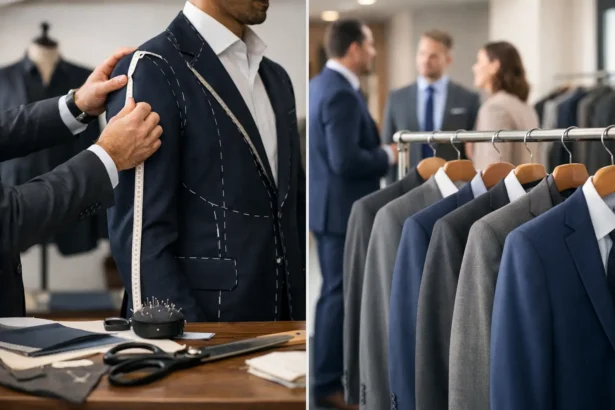
Made-to-measure corporate suits address those differences with precise measurement and fitting. A tailored approach allows each employee to receive garments that complement their proportions while maintaining a consistent overall silhouette. This is not about creating identical bodies or overly restrictive dress codes. It is about ensuring every team member looks intentional, comfortable, and ready for their role.
For larger teams, fit standards should be documented early. Defining jacket length, trouser break, skirt options, shirt cuts, and approved styling details makes future onboarding and replacement orders more efficient. It also protects the consistency of the original uniform design as the organization grows.
Fabric Must Work as Hard as the Team
Fabric selection is where appearance meets operational reality. A boardroom-based advisory firm may prioritize a fine wool blend with a structured drape. A hospitality team working long shifts in warm conditions may need breathable, wrinkle-resistant materials that retain their shape. Restaurant managers and guest relations staff may require fabrics with greater stain resistance and easy-care performance.
There is no single best fabric for every business. The right choice depends on climate, indoor temperature, employee movement, laundering practices, and the expected life cycle of the garment. A fabric that looks exceptional in a sample book but feels heavy after eight hours on the floor is not a successful uniform fabric.
A professional tailoring partner should explain these trade-offs clearly. Higher natural-fiber content can offer comfort and an elevated finish, while performance blends may deliver greater durability, easier maintenance, and better recovery after regular wear. The goal is to select fabric that supports the image of the business without creating unnecessary care requirements for employees.
Color and Details Carry the Brand
Corporate colors should be translated into apparel with restraint. A deep navy, charcoal, black, or neutral base often provides the versatility needed for daily business wear. Brand colors can then appear through lining, piping, neckwear, scarves, pocket squares, shirt accents, buttons, or embroidered logos.
This approach keeps the attire professional while ensuring it remains recognizable. A bright brand color may be highly effective as a subtle trim but overwhelming as the entire suit. Conversely, a conservative business may choose a nearly monochrome design and rely on precise tailoring, premium texture, and discreet embroidery to communicate quality.
Details deserve careful attention because they shape the final impression. Collar construction, lapel width, button placement, pocket design, stitching, and logo position should feel considered rather than decorative. Every element needs to align with the organization’s personality and the practical demands of the wearer.
Designing for Different Teams and Industries
A corporate suit should never be designed in isolation from the job it supports. A reception executive standing for much of the day needs different mobility and comfort than a senior manager attending client meetings. A hotel concierge may require an elevated, distinctive look, while a healthcare administrator needs a polished uniform that is easy to maintain and suitable for a fast-paced setting.
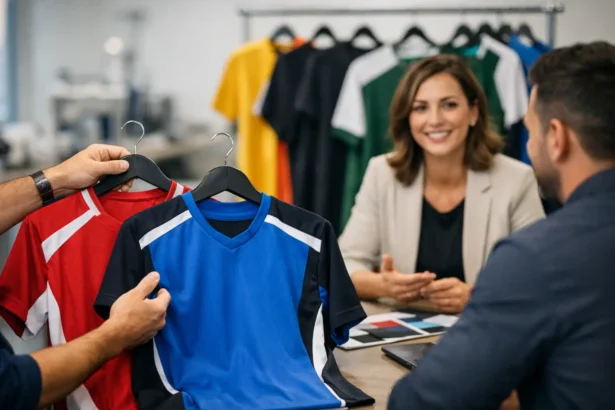
Hospitality organizations often benefit from layered designs. Blazers create a formal arrival experience, while tailored vests, shirts, and trousers provide flexibility during active shifts. Restaurants may combine branded shirts and aprons with tailored outer layers for managers and front-of-house leaders. Corporate offices may need a more classic suit collection that allows employees to maintain a formal standard without looking overly uniform.
Gender-inclusive options are equally important. Offering multiple cuts, sizing ranges, and practical garment choices allows employees to dress professionally without being forced into an unsuitable silhouette. Consistency should come from the shared design language – fabric, color, branding, and finish – not from limiting personal comfort or function.
A Better Process From Consultation to Delivery
Businesses achieve better results when uniforms are treated as a planned investment rather than a last-minute procurement task. The process should begin with consultation: who will wear the garments, what are their working conditions, how often will items be worn, and what should customers feel when they see the team?
From there, a tailored provider can develop suitable designs, recommend fabrics, prepare sizing guidance, and coordinate fittings. Samples are valuable because they allow decision-makers to assess comfort, color accuracy, movement, and overall appearance before full production begins. This stage is where small adjustments prevent costly dissatisfaction later.
Production planning matters as much as design. Companies should consider how many garments each employee needs, whether seasonal layers are required, and how replacement orders will be managed. Issuing only one suit to a staff member may reduce initial cost, but it can shorten garment life and leave little flexibility when cleaning or repairs are needed. Two or more coordinated sets are often more practical for roles with frequent wear.
Velcoor approaches this process as a partnership, combining design consultation, fabric selection, precise fitting, custom branding, and production support. The objective is not simply to deliver clothing. It is to create a professional apparel standard that teams can wear with confidence every working day.
Choosing Quality Over Short-Term Convenience
Lower-cost, ready-made uniforms can appear attractive at the point of purchase, particularly for organizations ordering for a large team. Yet the true cost becomes clearer when garments fit inconsistently, fade after repeated washing, lose their shape, or need replacing sooner than expected. These issues affect both budget and brand presentation.
A quality corporate suit program balances initial investment against durability, comfort, employee acceptance, and the impression made on customers. It also allows leaders to avoid the common problem of staff modifying uniforms independently because the original design does not fit or function well.
The best attire does not ask employees to choose between looking professional and doing their jobs comfortably. It gives them both – a considered fit, dependable materials, and design details that make the company’s standards visible from the moment they greet a client.