English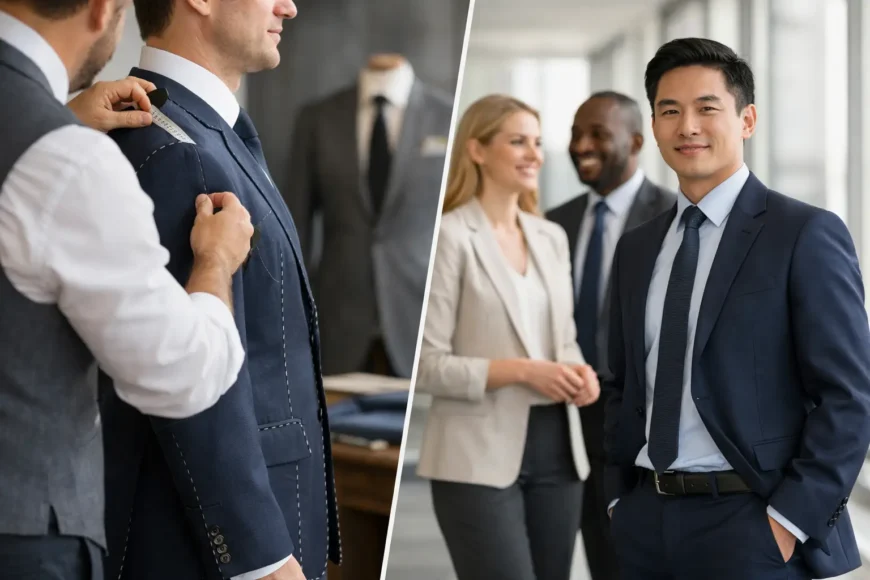
A front-desk team, sales department, or hospitality crew can represent the same company in completely different ways when their clothing fits inconsistently. The decision between custom suits vs off the rack is not simply about appearance or price. For business teams, it affects employee comfort, brand consistency, garment lifespan, and the confidence customers associate with your organization.
Off-the-rack apparel has a place when speed and a low initial purchase price are the main priorities. Custom tailoring becomes the stronger investment when professional attire must perform daily, represent a defined brand, and accommodate a real team rather than an average size chart.
Custom Suits vs Off the Rack: The Core Difference
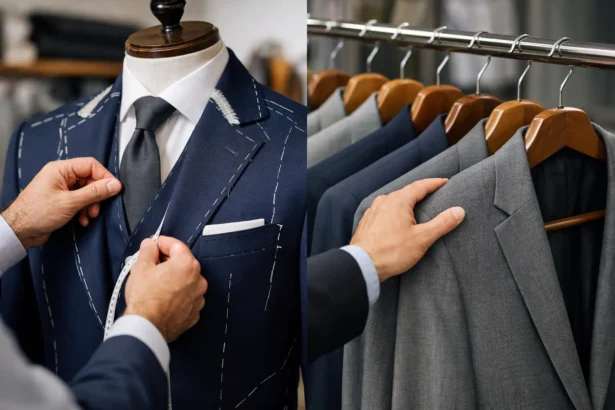
Off-the-rack suits are manufactured in standard sizes and sold as finished garments. They are designed to fit the broadest possible range of body types, often with limited room for adjustment. A business can select from available colors, cuts, and fabrics, but the garment itself is largely predetermined.
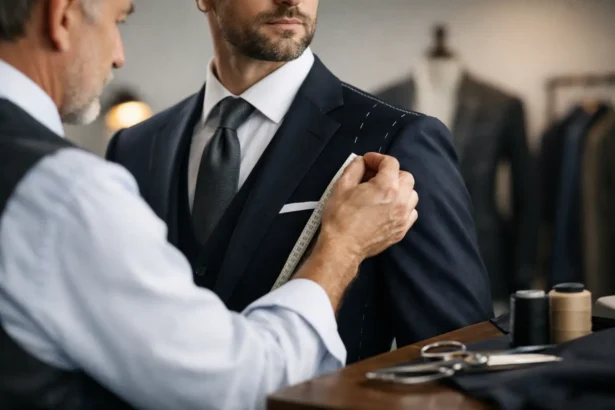
Custom suits are developed around the wearer and the organization. Measurements guide the fit, while fabric, silhouette, button style, lining, pockets, and finishing details can be selected to suit the role and the brand. For corporate programs, customization can also include embroidery, printed logos, coordinated shirts, skirts, pants, blazers, and role-specific uniform pieces.
That distinction matters because professional clothing is not worn once for an event. It is worn through client meetings, service shifts, presentations, commuting, standing, sitting, and repeated laundering. A uniform program has to work as hard as the people wearing it.
Fit Is More Than a Matter of Appearance
A well-fitted suit creates an immediate sense of polish. The shoulders sit correctly, the sleeves and trouser length look intentional, and the wearer can move without pulling at the back, chest, or waist. These details are visible to clients, but they also shape how employees feel throughout the day.
Ready-made suits can be altered, and this may be a practical solution for a small number of employees with straightforward fitting needs. However, alterations have limits. A tailor can adjust hems, sleeve lengths, and waist measurements, but cannot fully correct a jacket with shoulders that are too wide, an armhole that restricts movement, or an unsuitable jacket length.
For teams with varied body shapes and sizes, custom fitting offers a more consistent result. This is particularly valuable in customer-facing environments such as hotels, restaurants, clinics, financial offices, and reception teams, where every employee contributes to the visual standard of the business.
Comfort Supports Better Performance
Employees are more likely to wear professional apparel correctly when it is comfortable. A restrictive jacket may be tolerated during a short meeting, but it becomes a daily frustration for a concierge, restaurant manager, retail supervisor, or corporate representative who is constantly in motion.
Custom programs allow businesses to account for job demands. Stretch blends may suit active front-of-house teams. Breathable fabrics can support warm working environments. A more structured wool blend may be appropriate for executive-facing roles. The goal is not to make every employee wear the same garment, but to create a coordinated wardrobe that respects how each role operates.
Fabric and Construction Determine Long-Term Value
The lower upfront cost of off-the-rack suits can be appealing, especially when uniforms are needed quickly. Yet purchase price alone does not show the full cost of a garment. A suit that loses its shape, pills early, fades, or becomes uncomfortable after frequent wear may need replacement sooner than expected.
Custom suits provide more control over fabric quality and construction. Businesses can choose materials based on climate, expected wear frequency, maintenance requirements, and desired appearance. For example, a hospitality team may need wrinkle resistance and easy care, while a boardroom-facing team may prioritize refined texture and structure.
Construction also affects how a garment holds up. Strong seams, dependable lining, quality buttons, and thoughtful reinforcement in high-stress areas support daily use. This is especially relevant when ordering for an entire team, where inconsistent durability can create uneven appearances within a few months.
A custom solution is not automatically the right choice for every budget or timeline. But when garments are intended for regular, long-term use, better materials and craftsmanship often deliver stronger value over the life of the uniform program.
Brand Consistency Is Hard to Buy Off the Rack
Off-the-rack apparel can create a neat, acceptable appearance, but it rarely creates a distinctive one. Available shades may not match your brand palette. Cuts can vary between suppliers or seasons. When stock changes, replacing a discontinued item can leave new hires wearing something noticeably different from the existing team.
Custom apparel gives organizations control over the details that make a uniform recognizable. A blazer can be developed in a specific color. A logo can be embroidered with accurate placement and scale. Shirt collars, contrast trim, linings, buttons, and accessories can support the same visual identity without making the final look feel overly promotional.
This is where a uniform becomes part of the customer experience. A tailored hotel reception team signals order and service. A clinic team in coordinated, comfortable attire can reinforce reassurance and cleanliness. A financial advisory team in precise corporate suits communicates discipline and attention to detail before a conversation begins.
Cohesion Without Making Everyone Look Identical
A successful corporate wardrobe should create unity without ignoring different roles, preferences, or body types. Not every team member needs the same jacket, and not every role requires formal suiting. The stronger approach is to establish a consistent design language through color, fabric family, logo treatment, and overall level of formality.
For example, executives may wear tailored suits, while front-office employees wear matching blazers with branded shirts. Restaurant management may use a formal jacket, while service staff wear coordinated vests or aprons in the same fabric palette. This creates a clear hierarchy and a polished team image without forcing one garment onto every employee.
Speed, Sizing, and Operational Practicality
Off-the-rack clothing is usually faster to obtain because it is already produced. For an urgent event, a temporary staffing requirement, or a simple dress-code update, ready-made garments can be the most efficient option. If the desired size and color are in stock, a business can move quickly.
Custom production requires consultation, design approval, measurement, fitting, and manufacturing time. That process should be planned rather than treated as a last-minute purchase. The advantage is control: businesses can align the final garments with their operational requirements instead of adapting their requirements to what happens to be available.
Sizing management is also easier over time when a custom supplier maintains a clear specification for the program. New employees can be fitted to the same approved standard, and replacements can be ordered with greater consistency. This is a meaningful advantage for growing organizations, multi-location businesses, and teams with regular staff turnover.
How to Make the Right Choice for Your Team
The best choice depends on what the apparel needs to accomplish. Off-the-rack options may be appropriate when speed, basic formality, and minimal initial spend matter most. They can work well for small teams, occasional use, or roles where exact branding and daily performance are not essential.
Custom suits are a stronger fit when employees represent the business directly, garments will be worn frequently, and brand presentation needs to remain consistent across the team. They are also worth considering when standard sizing has created fit complaints, when your industry requires specific practical features, or when generic apparel does not reflect the quality of your service.
Before committing, define the working environment, expected wear frequency, laundering process, branding needs, and replacement plan. A well-designed program considers the entire employee experience, from the first fitting to the day a new team member joins.
For organizations that view staff attire as an extension of their service standard, Velcoor brings together consultation, precise fitting, fabric selection, custom branding, and dependable production. The right suit should not merely meet a dress code. It should help every employee show up looking prepared, credible, and part of a business that pays attention to detail.