English
A client’s first impression is often formed before the first greeting, proposal, or service interaction. Custom business suits give employees a refined, consistent presence that communicates care, capability, and confidence at every touchpoint. For organizations that rely on trust, from corporate offices and financial firms to hotels, clinics, and premium restaurants, professional attire is not simply a dress requirement. It is a visible part of the brand experience.
Ready-made suits can appear convenient at first, but they rarely address the realities of a diverse workforce, long operating hours, varying job functions, and established brand standards. A tailored program gives businesses greater control over fit, fabric, color, and finishing details while helping employees look and feel prepared for their roles.
Why Custom Business Suits Matter for Organizations
A well-designed suit creates visual consistency without making a team look generic. When employees wear garments that fit properly and reflect the organization’s identity, the result is a more polished workplace and a stronger customer-facing image.
Fit is central to this effect. A jacket that pulls across the shoulders, trousers that break awkwardly, or sleeves that sit too long can make even quality fabric look unprofessional. Made-to-measure sizing addresses common fit differences across employees, creating a cleaner silhouette and better comfort throughout the workday. This matters particularly for teams that meet clients, manage front-of-house operations, attend events, or represent leadership.
Custom tailoring also supports employee confidence. Staff members who are comfortable in their uniforms are more likely to wear them correctly and consistently. The difference is practical as well as visual: a well-fitted suit allows easier movement during presentations, guest service, site visits, and daily commuting.
Build a Brand Image Through Every Detail
Business attire should align with the way an organization wants to be recognized. A law firm may require a classic charcoal or navy suit with understated details. A luxury hotel may choose deeper tones, textured fabrics, and coordinated accessories that reinforce a premium guest experience. A restaurant group may need tailored blazers that feel sophisticated while remaining functional during active shifts.
The most effective custom business suits do not rely on a logo alone. Brand alignment can be expressed through fabric selection, button color, lining, piping, contrast stitching, pocket styling, and coordinated shirts or skirts. Discreet embroidery can add identification where appropriate, while custom printing may suit promotional teams or event uniforms. Each detail should support the overall image rather than compete with it.
Consistency is especially valuable for organizations with several departments. Reception teams, sales representatives, managers, concierge staff, and executives may have different responsibilities, yet their attire should still appear part of one visual system. A coordinated uniform program can use shared colors and finishes while adjusting garment styles for each role.
Choose Colors With Purpose
Color decisions should be guided by both branding and use. Navy, charcoal, black, and medium gray remain strong choices because they are versatile, professional, and easier to maintain in high-contact environments. They also provide a dependable base for branded shirts, ties, scarves, name badges, or embroidered details.
Lighter colors can work well in client-facing environments with a relaxed or contemporary identity, but they may require more frequent care. Bold colors can distinguish a hospitality or restaurant team, though they are best used with restraint. A suit must still look appropriate under different lighting conditions, across body types, and after repeated wear.
Fabric Selection Is a Business Decision
Fabric affects how a suit looks, feels, wears, and performs over time. For organizations purchasing apparel for a team, choosing material should involve more than selecting a color swatch. Consider the work environment, climate, laundering expectations, shift length, and expected frequency of use.
Wool and wool-blend fabrics offer a refined appearance, natural breathability, and excellent drape. They are often suitable for executive teams, finance professionals, and formal corporate settings. Blended fabrics may offer greater wrinkle resistance and durability, making them a practical choice for customer-service teams and employees who spend much of the day moving between locations.
For warmer climates or active workplaces, breathable lightweight fabrics can help employees stay comfortable without sacrificing a polished appearance. However, very lightweight materials may not hold their shape as well as a structured blend. The right choice depends on the balance between presentation, comfort, maintenance, and budget.
A professional tailoring consultation helps prevent costly mismatches. A fabric that looks exceptional in a boardroom may not be the right solution for hotel operations or restaurant service. The goal is to select materials that continue to look professional after repeated use, cleaning, and movement.
Design for the Role, Not Just the Dress Code
A single suit style is not always the best answer for every employee. Businesses achieve better results when the design reflects the actual demands of each position.
Executive and client-facing staff may benefit from structured jackets, premium lining, and traditional tailoring details that project authority. Reception and concierge teams often need refined garments with comfortable mobility for standing and greeting guests. Sales teams may require wrinkle-resistant materials that travel well. Healthcare administrators and clinic receptionists may need a softer, approachable look that remains formal and easy to maintain.
Women’s business attire also requires thoughtful planning beyond simply adapting a men’s design. Tailored blazers, pants, skirts, dresses, and coordinating blouses should be developed with fit, movement, and workplace practicality in mind. Offering appropriate style options helps create a professional standard while respecting individual comfort and role requirements.
Measure, Fit, and Refine Before Production
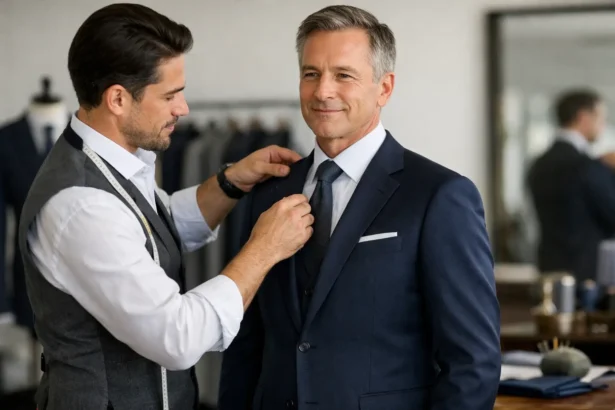
The measuring process is where a custom uniform program becomes meaningfully different from off-the-rack purchasing. Accurate measurements establish the foundation, but fitting is what confirms that the garment works in real life.
During fitting, attention should be given to shoulder alignment, jacket length, chest ease, sleeve position, trouser rise, inseam, and movement through the arms and back. Employees should be able to sit, reach, walk, and perform routine tasks without strain. Small refinements at this stage can significantly improve the final appearance.
For larger teams, a managed fitting process also creates operational value. It reduces guesswork, limits inconsistent sizing, and helps avoid the expense of ordering garments that are rarely worn because they do not fit. Accurate records can also make future reorders more efficient when new employees join the organization.
Plan for Durability and Long-Term Consistency
A suit program should be evaluated over its working life, not only at the point of purchase. Lower-cost garments can seem attractive initially, but premature fading, seam wear, poor shape retention, and inconsistent replacement stock can undermine the intended savings.
Quality construction supports daily use. Reinforced seams, reliable closures, suitable lining, and carefully selected fabrics help garments retain their professional finish. Employees should also receive clear care guidance so that the investment is protected. In some roles, providing more than one set of garments may be more practical than expecting a single suit to carry a full workweek.
Long-term planning also includes consistency for future hires. Establishing approved fabrics, colors, design specifications, and branding placements makes it easier to maintain a unified look as teams grow. This is particularly important for multi-site businesses, hotel groups, restaurant chains, and organizations with frequent recruitment cycles.
A Consultative Approach Produces Better Results
The strongest corporate attire programs begin with questions. Who wears the garments? What tasks do they perform? How often will each piece be worn? What impression should customers receive? Which brand elements need to be visible, and which should remain subtle?
Velcoor approaches these decisions as both a tailoring and business-image project. Through consultation, fabric guidance, custom design, precise fitting, and production support, organizations can create apparel that serves their people as well as their brand. The objective is not to put every employee in the same outfit. It is to create a consistent standard that feels appropriate, comfortable, and unmistakably professional.
The right suit program gives employees more than a uniform to wear. It gives them a clear, confident way to represent the organization every time they step into the workplace or meet a client.