English

The Smart Buyer’s Guide to Custom Blazer Malaysia
THE STYLE EDIT | BESPOKE FASHION & MODERN TAILORING
A blazer is more than a wardrobe essential. It is a statement of proportion, personality, and purpose. Here is what every smart buyer should know before investing in a custom-made blazer in Malaysia.
There is something unmistakable about a blazer that fits beautifully.
The shoulders sit naturally. The waist follows the body without restriction. The lapels frame the chest with confidence, and the overall silhouette feels effortlessly polished.
It does not demand attention through an extravagant label or an oversized logo. Its distinction comes from the way it fits, moves, and complements the person wearing it.
Yet finding that perfect blazer is rarely as simple as choosing a familiar size from a clothing rack.
For professionals exploring Custom Blazer Malaysia, the real opportunity goes beyond ordering a jacket in a preferred colour. Custom tailoring opens the door to personalised proportions, individual design preferences, carefully selected fabrics, and a garment created around the wearer’s lifestyle.
But not every custom blazer offers the same level of craftsmanship, design flexibility, or value.
This guide explores what makes a custom blazer worth buying, how to evaluate different tailoring options, and why thoughtful design decisions matter more than simply following the latest fashion trend.
01 | Beyond the Rack: Why Custom Matters
The difference between wearing a blazer and owning your silhouette.
Ready-to-wear blazers are manufactured around predetermined measurements and standard body proportions.
A size M or size 40 might accommodate the chest but feel restrictive across the shoulders. A jacket that fits comfortably around the waist may have excessively long sleeves. For women, differences in bust, waist, and hip proportions can make finding a well-balanced blazer even more challenging.
Custom tailoring approaches the problem differently.
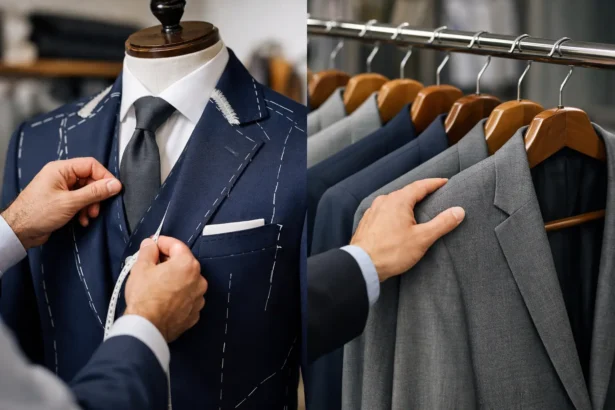
Instead of asking the individual to adapt to the garment, the garment is developed around the individual’s measurements, proportions, preferences, and intended use.
The advantages extend beyond size.
A customer may prefer a softly structured shoulder, a longer jacket to balance their proportions, or a higher button position to create a particular silhouette. Others may want a contemporary oversized blazer inspired by luxury fashion collections.
These decisions are difficult to accommodate through standard retail sizing.
THE STYLE NOTE
“A good blazer fits your body. A remarkable blazer understands your proportions.”
The value of custom tailoring lies in achieving that balance between appearance, comfort, and personal expression.
02 | The Blazer Personality: What Is Your Style?
Every silhouette tells a different story.
Before choosing fabric or discussing measurements, consider the impression your blazer should create.
Not every blazer belongs in the same wardrobe.
The Executive Blazer
Structured, refined, and designed to project authority.
The executive blazer often features balanced shoulders, controlled waist shaping, and classic notch or peak lapels. Navy, charcoal, black, and understated earth tones remain versatile choices for professional environments.
Ideal for business meetings, management roles, corporate presentations, and formal office settings.
The Contemporary Slim-Fit Blazer
A sharper silhouette with closer body shaping and a streamlined appearance.
Its success depends on careful proportion rather than making every measurement tight. The chest should remain comfortable, the sleeves should allow movement, and the button should close without significant pulling.
Ideal for professionals who favour modern, fitted tailoring.
The Relaxed Luxury Blazer
Soft construction, comfortable proportions, and a less formal attitude.
This style works beautifully with lightweight textiles, open-collar shirts, fine knitwear, or tailored casual trousers.
Ideal for creative professionals, business travel, weekend occasions, and smart-casual dressing.
The Double-Breasted Statement
Confident, architectural, and unmistakably sophisticated.
A double-breasted blazer uses overlapping front panels and a distinctive button arrangement to create a stronger visual presence.
Peak lapels are a popular pairing, although the exact styling can be customised.
Ideal for fashion-forward executives, formal events, and individuals who appreciate classic European tailoring.
The Women’s Power Blazer
Modern women’s tailoring is no longer restricted to conventional office silhouettes.
A tailored women’s blazer can feature sculpted waistlines, cropped lengths, longline proportions, oversized shoulders, feminine curves, or deliberately androgynous styling.
The most effective design complements the wearer’s proportions while expressing individual style.
Ideal for corporate dressing, contemporary professional wardrobes, special occasions, and personalised fashion collections.
03 | Fabric Intelligence: Dressing for Malaysia’s Climate
Luxury is not just how a fabric looks. It is how comfortably it performs.
Malaysia presents a distinctive challenge for tailoring.
Outdoor heat and humidity contrast with air-conditioned offices, meeting rooms, shopping centres, and event venues.
A blazer may need to remain comfortable during a commute while still looking structured in a corporate environment.
This makes fabric selection one of the most important decisions when purchasing a custom blazer in Malaysia.
Tropical Wool: Naturally Refined
Lightweight tropical wool, particularly in breathable open-weave constructions, is a strong choice for professional tailoring.
It can provide elegant drape, good recovery, and a polished appearance without relying on excessively heavy cloth.
However, wool composition alone does not determine comfort. Fabric weight, weave, lining, and garment construction also influence how warm or breathable a jacket feels.
Wool Blends: Versatility with Character
Wool-blended suiting materials combine wool with other fibres to achieve different combinations of texture, durability, wrinkle behaviour, drape, and cost.
The characteristics depend on the specific blend rather than the label alone.
They are suitable for buyers seeking a balance between formal appearance and everyday practicality.
Linen and Cotton Blends: Relaxed Sophistication
Linen brings a natural texture and relaxed visual character that complements casual and semi-formal blazers.
Cotton-linen blends offer additional styling possibilities, although creasing remains part of their appeal and should be considered before purchase.
They are particularly attractive for summer-inspired fashion, casual business settings, and creative wardrobes.
Performance Suiting: Built for Movement
Modern synthetic and blended textiles may offer easy-care characteristics, stretch, shape retention, and other functional properties.
These fabrics can be useful for uniforms, travel blazers, and frequent daily wear.
Nevertheless, stretch does not automatically mean breathability, and wrinkle resistance should never be confused with overall fabric quality.
THE FABRIC RULE
Choose the fabric for the environment you actually live and work in, not simply for how luxurious it sounds.
Ask to inspect real fabric samples, compare their thickness and texture, and understand their maintenance requirements before approving the design.
04 | Anatomy of a Beautiful Blazer
The smallest details often create the strongest visual difference.
A custom blazer is defined by a series of deliberate design decisions.
The key is knowing which elements influence appearance, which affect construction, and which contribute to everyday comfort.
Lapels: The Frame of the Jacket
The lapel influences how the entire upper body is perceived.
Notch Lapel: Classic, versatile, and suitable for business and smart-casual blazers.
Peak Lapel: More assertive and formal, creating a strong visual line toward the shoulders.
Shawl Lapel: Smooth and continuous, commonly associated with eveningwear and refined occasion jackets.
Lapel width also matters. A wider lapel can create a more substantial appearance, while a narrower lapel may contribute to a contemporary streamlined silhouette.
Shoulders: Structure Without Stiffness
The shoulder line determines much of a blazer’s character.
Traditional structured shoulders create definition and formality. Softer shoulders offer a relaxed appearance.
The correct choice depends on the intended silhouette, shoulder proportions, fabric, and garment construction.
Jacket Fronts: Buttons with Purpose
Single-breasted blazers commonly use one, two, or three front buttons, with two-button styles remaining a versatile classic.
Double-breasted designs offer several button arrangements and a more architectural front.
Button position affects the jacket’s visual proportions, particularly the apparent waistline and torso length.
Pockets: Function Meets Aesthetics
Flap pockets provide a familiar tailored appearance.
Jetted pockets create a cleaner, more formal line, while patch pockets bring a relaxed character.
Ticket pockets, angled pockets, and other variations can add personality without overwhelming the garment.
Vents: Designed for Movement
A single centre vent creates a traditional look.
Double side vents can provide greater freedom around the hips and help the back of the jacket sit comfortably when moving or sitting.
Ventless construction produces a clean back silhouette but may be less practical for certain body shapes or activities.
Linings and Interior Details
Full lining, partial lining, and unlined construction each offer different trade-offs in appearance, interior finishing, weight, and comfort.
Personalisation can extend to buttons, contrasting undercollars, sleeve buttonholes, monograms, and internal pockets.
However, thoughtful restraint is often more elegant than adding every available option.
05 | What Does a Better Fit Actually Mean?
Good tailoring is measured in balance, not tightness.
One of the biggest mistakes buyers make is assuming that a slimmer blazer is automatically a better-fitting blazer.
A jacket that pulls across the chest, restricts arm movement, or forms pronounced tension lines around the waist is not necessarily well fitted, even if it looks close to the body.
A properly fitted blazer should accommodate natural posture and movement while maintaining its intended silhouette.
Pay particular attention to five areas:
Shoulder balance: The shoulder line should follow the intended design without unwanted overhang or distortion.
Chest comfort: The front should close naturally without excessive pulling, while preserving the desired shape.
Waist shaping: The waist should complement body proportions without creating uncomfortable tension.
Sleeve proportion: Sleeve length and width should work with the chosen shirt, wrist position, and overall silhouette.
Jacket length: The length should balance the wearer’s torso, legs, and styling objectives.
For women, bust shaping, button placement, hip allowance, and jacket length often require additional consideration.
For men, differences in posture, chest prominence, shoulder slope, and waist proportions can influence the finished fit.
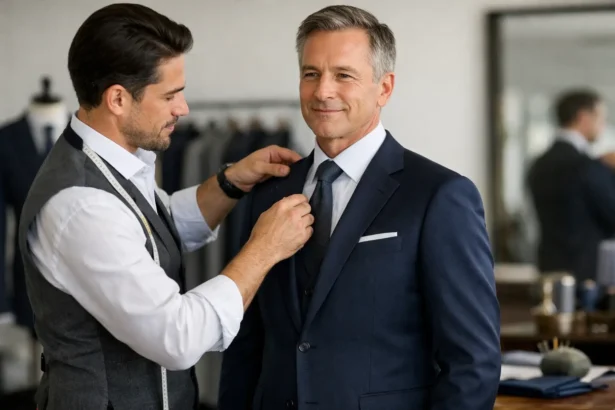
A fitting session should evaluate the blazer both while standing and in natural movement.
FIT IS NOT A NUMBER. IT IS A RELATIONSHIP BETWEEN THE BODY, THE GARMENT, AND ITS DESIGN.
06 | Bespoke, Made-to-Measure or Made-to-Order?
Understanding what you are actually paying for.
The word custom is widely used in the fashion industry, but different tailoring services can involve substantially different production methods.
| Tailoring Method | What It Typically Means |
|---|---|
| Made-to-Order | A selected design is produced after ordering, often with predetermined specifications |
| Made-to-Measure | An existing pattern is adjusted according to individual measurements and available design options |
| Bespoke | A pattern is developed for the individual, generally allowing broader control over fit and design, with fittings as required |
The distinction is important because customisation does not always mean unlimited design freedom.
Some services allow fabric and button selections but offer only a limited range of jacket styles.
Others accommodate major changes to lapels, construction, shoulders, pockets, and proportions.
Before making a purchase, ask which design changes are genuinely possible and whether the quoted price includes the chosen specifications.
Also ask whether the jacket uses fused, half-canvas, or full-canvas construction where applicable, and how the supplier supports alterations and fitting adjustments.
A more expensive construction method is not automatically the correct choice for every lifestyle, but customers should understand the differences before deciding.
07 | The Real Cost of a Custom Blazer in Malaysia
Why two similar-looking blazers can carry very different prices.
A custom blazer’s price reflects more than its outer appearance.
Fabric composition and sourcing, pattern development, internal construction, fitting procedures, production workmanship, design complexity, and after-sales services all influence the final quotation.
For example, a fully lined blazer using premium imported wool and more elaborate internal construction may require more materials and labour than a simple lightweight casual jacket.
Similarly, an unusual lapel design, additional pockets, specialised buttons, or a highly customised silhouette may involve extra pattern and production work.
When comparing quotations from tailoring companies in Kuala Lumpur, Petaling Jaya, Selangor, or elsewhere in Malaysia, request a clearly itemised specification.
Check what is included in the price, whether alterations are provided, how many fittings may be needed, and whether design modifications incur additional charges.
Be cautious about assuming that a fabric’s country of origin, an expensive lining, or a luxury label alone guarantees superior workmanship.
THE BUYER’S RULE
Compare the finished garment specification, not just the price tag.
08 | Customising Your Blazer Without Overdesigning It
Personalisation is most successful when every detail has a reason.
One of the greatest advantages of custom tailoring is the freedom to create a garment that reflects individual taste.
However, more design features do not necessarily mean a better blazer.
A fashionable contrast lining, bold buttons, wide lapels, unusual pocket shapes, and decorative stitching may each be attractive independently.
Combining all of them can produce a garment that lacks visual harmony.
Start with the silhouette.
Then choose the fabric, lapels, button arrangement, and pocket details that support the intended appearance.
A classic navy executive blazer might benefit from understated buttons and a refined lining. A cream linen blazer may look more natural with patch pockets and relaxed shoulder construction. A fashion-led double-breasted design may call for stronger lapels and a carefully considered button layout.
The most successful customisation often feels effortless because the choices belong together.
09 | One Blazer, Multiple Wardrobe Possibilities
The smartest custom blazer is the one you actually wear.
A blazer should not be judged only by how impressive it looks during the first fitting.
Its long-term value depends on how well it integrates into the wearer’s existing wardrobe.
Consider a versatile navy blazer.
For corporate meetings, it can be paired with tailored trousers and a formal shirt. For a smart-casual environment, it works with chinos or well-fitted denim. For evening occasions, a change of shirt, trousers, and accessories can create an entirely different impression.
Women’s custom blazers offer equally broad styling possibilities.
A structured blazer may complement tailored trousers during the working day, coordinate with a pencil skirt for formal appointments, or bring sophistication to a dress for an evening event.
Colour coordination plays an important role.
Rather than selecting fabric in isolation, consider the shirts, blouses, trousers, skirts, shoes, and accessories already in the wardrobe.
Neutral shades generally provide greater versatility, while distinctive colours and textures can form the centrepiece of a more expressive outfit.
A thoughtful custom blazer should expand wardrobe possibilities rather than create another garment that is difficult to match.
10 | Corporate Blazers: When the Buyer Represents an Entire Team
Individual style meets collective identity.
Custom blazers are not limited to personal wardrobes.
For businesses, tailored blazers can contribute to a coordinated professional image across management teams, customer-facing employees, reception staff, and corporate representatives.
However, designing for a group introduces additional considerations.
The chosen fabric must be suitable for regular wear. The silhouette should accommodate different body shapes. Sizing methods need to be practical, and the design should remain reproducible when new employees join.
An organisation may select one shared fabric colour while allowing separate men’s and women’s patterns, or use several coordinated silhouettes within the same corporate identity.
Consistency is achieved through agreed design specifications rather than requiring every employee to wear exactly the same shape.
For group orders, buyers should document the approved fabric reference, blazer style, buttons, lining, logo requirements, size distribution, and production details.
A reliable repeat-order system is particularly valuable for maintaining a consistent appearance across future batches.
11 | Seven Questions to Ask Before Ordering
A smart buyer’s final checklist.
Before purchasing a custom blazer in Malaysia, ask the tailoring company:
Can I customise the entire design? Clarify whether changes to lapels, shoulders, jacket length, pockets, buttons, and fit are permitted.
What is the exact fabric composition? Request details on the fibre blend, weight, performance, and care requirements.
What construction method will be used? Ask about fused or canvas construction, lining, and internal finishing.
How are measurements taken? Find out whether the process uses a professional tailor, submitted measurements, digital scanning, or a combination.
Will there be a fitting? Understand the fitting process and how adjustments are handled.
What is the full production timeline? Confirm the delivery date, especially for weddings, events, and corporate orders.
What happens after delivery? Ask about alterations, remake policies, care instructions, and the availability of measurement records for future purchases.
Clear answers are usually more valuable than an impressive sales presentation.
A professional tailoring process should help customers understand what they are buying and what they can reasonably expect.
The Final Edit | Buy Design, Not Just a Blazer
The appeal of custom tailoring is not simply the ability to choose a different colour or add personalised initials.
It is the opportunity to build a garment around the wearer’s body, lifestyle, professional needs, and personal aesthetic.
For anyone searching for Custom Blazer Malaysia, the smartest decision begins with understanding fabric, fit, construction, design flexibility, and service—not merely comparing promotional prices.
A beautifully tailored blazer does not need to be extravagant to make an impression.
It needs the right proportions, the right materials, thoughtful construction, and a design that belongs to the person wearing it.
Because the best blazer is not necessarily the one everybody notices. It is the one that makes its wearer look effortlessly distinctive.